

(Mamma)L
No substantive magic against death

To those who gift me your attention and support, I wonder how you’re doing. I hope you’re nurturing your hearts, strengthening your relationships, and finding opportunities to resist, if not refuse, the arrogation of your minds. I have been slow to write but metabolizing much. You have been with me. Love, Finn
I sometimes boast to myself about my mental health. Just not when I’d rather be writing, but opt for staring at my email inbox as if it were an open window, refreshing it every few seconds, cascading into minutes. Or opening the refrigerator, searching again for something—I don’t even know what—that wasn’t there last time I checked, less than an hour ago.
Occasionally, after having driven away from my house, I drive back to make sure the stovetop flame is out. “The garage door is shut,” I say. “I’m looking at the door, and it’s shut.” Which releases me back to the road, a ritual invoking the magic of getting shit done. What shit, I don’t know.
I often scroll on Instagram with no recollection of what I’ve seen. Or, worse, bloody images from Gaza flit indistinctly beneath my thumb into a stream of advertisements for jockstraps and muscle tees—to which I respond by saving a cart full of underwear for later. I rarely intend to buy; it’s just that someday…I could be that fit, White guy.
But I am that fit, White guy.
Remembering this does nothing to fill the banality of longing. Nor rescue a fantasy distilled from rivers of blood. This is not hyperbole. Just scroll.
I have been waiting for hours in front of a blinking cursor, coaxing thoughts to form. By now, I’ve seen multiple angles of videos of ICE agent Jonathan Ross in Minneapolis shooting 37-year-old protestor Renée Good in the face. One clip, in slow motion. Despite Good’s tires turning obviously away from Ross—because she was trying to escape a masked stranger barking, “Get out of the fucking car”—the Department of Homeland Security insists Good “weaponized her vehicle, attempting to run over our law enforcement officers in an attempt to kill them.” Allegedly, Ross, “fearing for his life, the lives of his fellow law enforcement, and the safety of the public,” acted in self-defense.
Oh, I totally buy that—but only on the terms that “self” is a sutured-over bottomless pit where once was a little boy.
To justify (and commodify) Good’s murder, Fox News host Jesse Watters felt moved to highlight that Good had pronouns in her social media bio and a lesbian partner. I have seldom felt as much hatred as was inspired by his condescension. Or fear. Because bullets in queers have entered primetime, cruelty-porn entertainment.
Of course, police shooting people in cars is nothing new if you’re a Black man. That Good’s murder scares me most, while, in total, thirty-two people died in 2025 in ICE custody, is not solely due to the horrific circumstances of her death, nor its regime-catalyzing velocity.
Just that the earnest rituals of Whiteness invoke no substantive magic against death.
Although gunless, I’m not blameless, because a shameful part of me is easily distracted by pleasure in despising Kristi Noem, her lashes like torn raven wings over rattlesnake eyes. But I can’t delude myself that it’s not residue of the same poison coursing through my veins as Ross’s. Not enough to kill, but sufficient to stain even the “right side of history.” Whichever way that is while spiraling.
None of this is mental health—just dismemberment disguised as safety. My forty-six years seem not to have plucked from my still-waiting body a wish for my mother to rescue me from the violence of my father. Nor memories of her own participation. She was the lesser evil by far—but clinging to what was never there occludes my internalized misogyny. And a secret belief that the majority of men are already dead. I don’t want to give up on them.
Or myself.
Okay, I’ve been molded into submission, but I fervently seek new shapes of mind and action. This idea is not novel: inside and outside as reflections. It is human, insofar as we replicate imagination, millennia of mothers and fathers constellated within. We are repetitions of flesh in a spectrum of power relations, scaffolded by the meanings we scavenge and plaster over…well, nothing, really. And at every turn of resistance—inside and out—power reconstitutes itself. Our collective terms are laid out in plain sight: subordinate yourself or die.
But maybe resisting the seduction of looking away (in self-defense) sutures a head to a heart. Even as it gapes wide enough to bathe terror, grief, helplessness, rage, and overwhelm in its lifeblood. I’m beginning to understand how rage can spring from love, but my body is still catching up, because the paralysis of individual subjecthood is a downstream process of colossal forces that, if to be stopped, require a deliberate, ongoing appropriation of death. If not running straight for it. Together.
A desperate part of me rejects this truth. This is easy to spot. Just scroll.
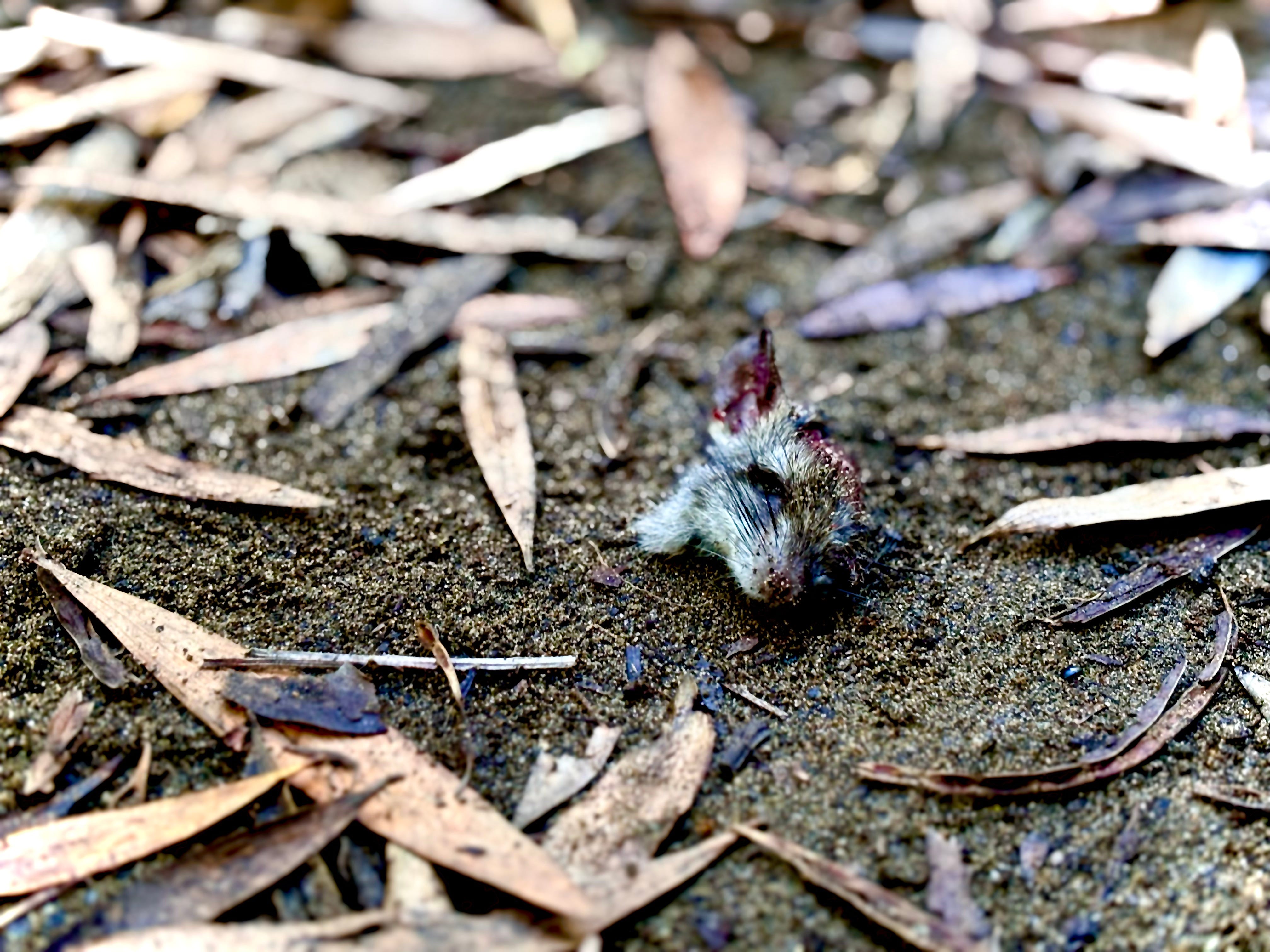
I don’t want to label it as a compulsion, taking pictures of dead things. I’d like to think of it as a message, but who knows. On a beach hike with my husband and dogs, I almost stepped on the bloody head of a small mammal whose body was nowhere to be found. Nearby, in a pile of dry leaves, were its entrails coiled with the tidiness of a murder. Because it was mangled, I wasn’t sure if it was a squirrel—but the sunlight making its blood glow in a perfectly scattered frame of leaves was a composition too perfect for human hands to have arranged.
Fuck! We’d purposely left our phones at home in an effort to carve ourselves away from notifications and clock time. Fully present.
Well.
For the next half hour, I obsessively searched up and down the trail for a fellow hiker who just might’ve happened to have an iPhone. I’d take a picture and text it to myself, wasn’t going to leave until I got one. All the while, my husband pleaded, “Babe, let it go.”
So, unabashedly refusing to let it go, I drove him and the dogs back home. No, he said, he wasn’t frustrated. (He was.) No, he didn’t want to accompany me back to the beach. He did wonder aloud, What if I just stayed to have sex? Even better, I retrieved my phone and sped back to the sandy trail. My limbs were electric, and my pulse raced; it could have been a first-time hookup, the way I sprinted all the way back to where I’d first seen the head.
When I found it, it had moved a good few feet from where it had previously been. Maybe kicked by a thoughtless hiker or a chew toy for a dog, I didn’t know. I panicked. No amount of maneuvering would configure it back to how I’d originally found it: an epistle, deific and silently frenzied among the leaves. Now just a glimmer of what no longer was. Seconds cascaded into minutes, and each adjustment I made only furthered my disappointment. Sure, I took dozens of pictures, but clinging had eclipsed the art.
Later, I showed the images to a few friends.
“That’s not a squirrel,” said one.
“Yes, it is,” said another.
We googled squirrel heads, chipmunk heads, rat heads, and, who knows why, but groundhogs.
“Y’all, we are so fucked.” Concluded the first. “We don’t even know what this animal is.”
We all laughed—but we knew what he meant: We are heads severed from the bodies we feed, fuck, medicate, and abstract. Distract. Even writing this post, I couldn’t help myself from chasing a clickbait article that claimed, to protect myself from break-ins, I should always wrap tin foil around my house doorknob when alone. Noted. But this is definitely not mental health.
Not like running full speed at death and praying (a human ritual invoking what magic I don’t know) that it steps back, if only just long enough to live.
My heart is open. I double-check throughout the day. I feel my heart, and it’s open.
In Powers of Horror: An Essay on Abjection, Julia Kristeva writes:
We may call it a border; abjection is above all ambiguity. Because, while releasing a hold, it does not radically cut off the subject from what threatens it—on the contrary, abjection acknowledges it to be in perpetual danger. But also because abjection itself is a composite of judgment and affect, of condemnation and yearning, of signs and drives. Abjection preserves what existed in the anarchism of pre-objectal relationship, in the immemorial violence with which a body becomes separated from another body in order to be—maintaining that night in which the outline of the signified thing vanishes and where only the imponderable affect is carried out. (10)
Said differently, a return to the blood and guts of Mamma. The Mamma.
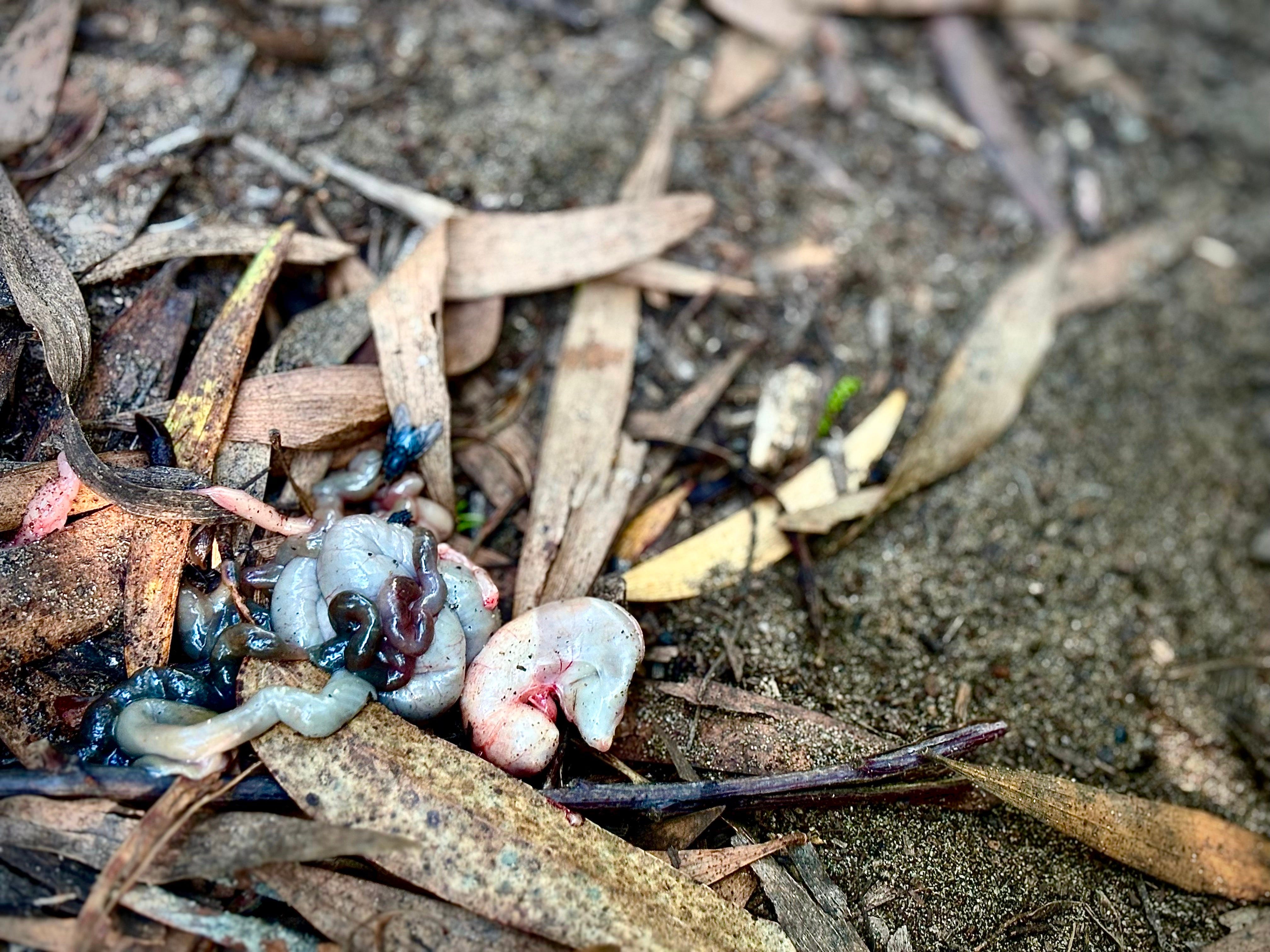
“ … getting shit done …”.
In the pursuit of knowledge, everyday something is added. In the practice of the Tao, everyday something is dropped. Less and less do you need to force things until finally you arrive at non-action. When nothing is done, nothing is left undone.
True mastery can be gained by letting things go their own way. It can’t be gained by interfering.
#48, Tau Te Ching 道